Positioned for Growth: Aria’s Enhanced AI Capabilities in a Rising Industry
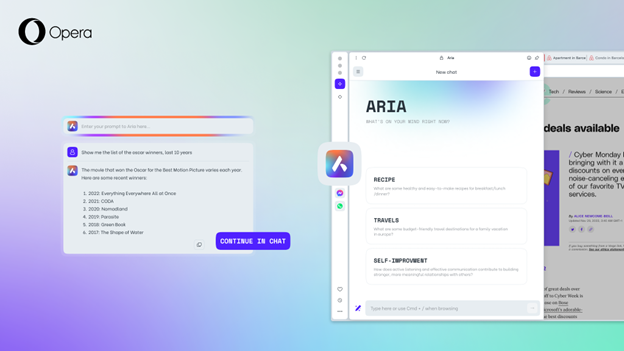
Artificial intelligence is transforming industries at a global scale, with the AI market projected to grow at an annual rate of 28.46% (CAGR 2024-2030) and reach a market volume of $826.7 billion by 2030. This growth is driven by increasing demand and adaptation of AI technologies in various sectors with Opera at the forefront of this transformation, integrating AI into its product ecosystem and leading innovation in web browsing.
The Rising Demand for AI
In a survey conducted by Opera*, nearly 70% of respondents indicated they use an AI-based tool or service at least once a week. 45% mentioned they use AI for work and professional purposes. According to recent research from Gartner, three-quarters of CEOs have experimented with ChatGPT, and 44% have incorporated it into their work. Additionally, 87% of CEOs believe in the significant benefits of artificial intelligence, as reported by CNBC.
Bringing AI to Opera’s User Base
Opera recognised this trend early on and positioned itself as a frontrunner in AI integration for web browsing. Opera was among the first to integrate technologies like OpenAI’s ChatGPT into its browsers, and quickly developed AI Prompts – with which users could quickly initiate conversations with generative AI services to assist in a range of functions – to pioneer new ways of enhancing how users interact with the web. Then in May of 2023 Opera introduced Aria, its own built-in browser AI, enabling real-time web interactions and content generation.
Powered by Opera’s Composer infrastructure, Aria can choose from myriad LLM models – over 2,000 now, including OpenAI’s GPT and Google’s Gemini – so users can select the LLM that best suits their needs.
By recently removing the login requirement for Aria, Opera lowered the barriers to access so more users can experience Aria's AI capabilities and enjoy a new way of browsing. Since its launch, Aria has amassed millions of users and is available in 180+ countries, reflecting the growing demand for AI-enhanced browsing.
Transforming Browsing with Aria
Opera One has been built from the ground up to leverage AI functionalities. Aria’s integration into Opera One marks the beginning of an AI-driven browsing experience, enabling dynamic adaptation to users’ needs. Aria serves as both a web and browser expert, helping users to collaborate with AI to find information, generate content, and provide analytics. Aria is a comprehensive tool for both everyday browsing and more advanced tasks, offering both breadth and real-time capability.
In addition to real-time web data processing, Aria offers Image Generation based on Google’s Imagen3 Fast model, allowing users to create custom images from text prompts – ideal for content creators and professionals. The Image Understanding feature furthermore enables users to analyze and interact with uploaded images, whether to identify objects, solve handwritten equations, or generate new, refined versions of sketches.
Additionally, Aria offers a shortcut access point called the Command Line which can generally be reached by pressing Ctrl+/ on Windows and CMD+/ on Mac.** The Command Line has been designed for quick, streamlined interactions that don’t disrupt the users’ browsing activities, and it also gives the option to continue using Aria in a normal chat. From the Command Line users can pose queries to Aria, generate images or even switch to Page Context Mode by pressing the Tab key. The Page Context Mode lets Aria use the content of the webpage that the user is currently on when prompting Aria, helping them to do page deep-dives, summaries or explore the topic further.
The future of AI in web browsing is fascinating, and Opera is leading the charge with initiatives like AI Feature Drops. Launched in March 2024, this initiative allows users to test cutting-edge functionalities in the Developer version of Opera One, ensuring that Opera remains at the forefront of AI advancements. The AI-enhanced browser market is expected to contribute to a $25 billion industry by 2030, and Opera is positioned to be a part of this growth as it continues to innovate.
In April 2024, Opera became the first major browser to integrate local large language models (LLMs), adding support for more than 2,000 local LLM variants from over 60 model families in its Developer channel.
Financial Growth Powered by AI
In Opera's Q3 2024 earnings report, the company achieved notable growth with revenue rising to $123.2 million, marking a 20% increase year-over-year, and an adjusted EBITDA of $30.8 million with a margin of 25%. This growth reflects the impressive potential of Opera’s strategic focus on AI-driven innovation. The release of Opera One R2 introduced enhanced AI capabilities highlighting the market’s positive response to Opera’s continuous AI enhancements.
Aria’s new functionalities, like Image Generation and voice capabilities, have not only expanded Opera’s value proposition, but have also positioned the company competitively in a growing AI-centric market. This suite of AI tools meets industry demands for smart, adaptive browsing and supports Opera’s forecasted full-year revenue growth of 19%.
Sustainability at the Heart of AI Operations
Opera’s commitment to AI goes hand-in-hand with its focus on sustainability. Recognizing the energy demands of artificial intelligence, Opera has invested in a green-powered AI data center in Iceland, ranked among the world’s top 110 supercomputers. This facility allows Opera to scale its AI services while minimizing the environmental footprint, aligning Opera's operations with global sustainability goals.
*The survey was conducted by Opera between July 22nd and 14th of October, 2024, via Survey Monkey. The target population was identified as 18-65 years old, all genders, located in the US. There were 987 respondents overall.